
How the Manx language helps create a sense of 'Manxness'

Guest post written by Dr Erin McNulty // Dr Éirinn Nic An Ultaigh, Research Associate at the Gaelic Connect Project, University of Glasgow.
We often hear a lot of talk about ‘identity’, but what does it mean?
The answer to that is a complex one, as you might expect, but experts have come up with various broad definitions, such as identity being your “sense of self” and being linked to how you view yourself relative to other people in the world.
In the Isle of Man, we are currently dealing with the question of how we want to define a Manx identity, some of which you might have come across at your local Shoprite (sorry, Tesco!):
In the Manx case specifically, research shows that there are many ways that people express a Manx identity. This may be through engaging in cultural activities and festivals, such as Tynwald Day.
However, language has been shown to be an essential part of how we shape, understand, and express our identities, both as individuals and as groups. When we think of a particular culture or group of people, we often think of the way they speak, whether that is their accent, regional words they might use, or another language entirely.
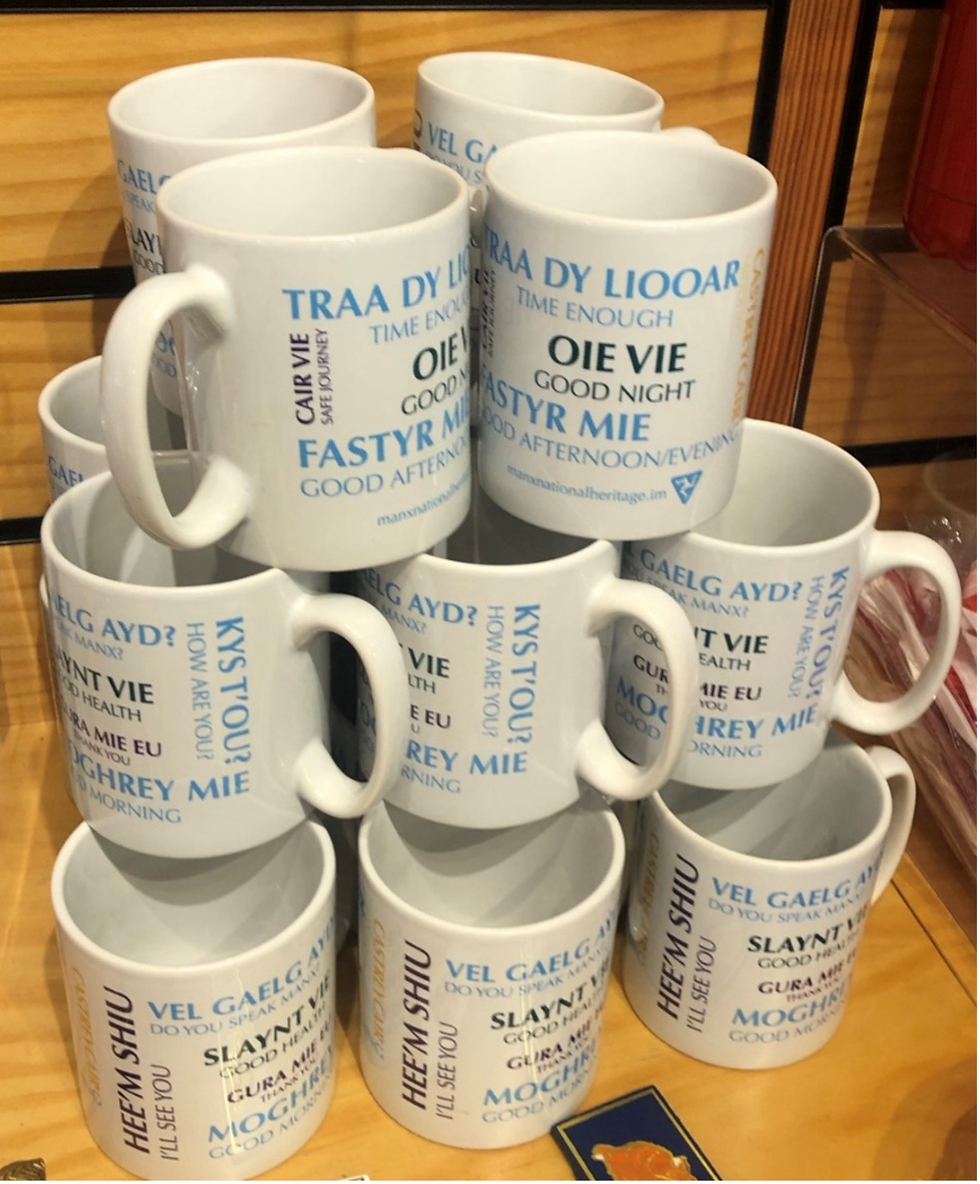
Research in the Isle of Man reveals that people often express their identity by buying products that have Manx Gaelic on them.

When we’re talking about languages that have small communities of speakers, like Manx, the relationship between language and identity is often complicated.
Research shows that, in smaller language communities like that of Manx, where people often speak more than one language, people may have different “cultural selves”. They may identify both with their local language and with the majority language (English, in this case).
A few years ago I undertook a linguistic research project in the Isle of Man where I explored how the Manx language is being used today. One of the areas I wanted to look at more closely was how Manx speakers felt about the link between language and identity. Having grown up here, I had some idea about how complicated an issue it can be!
My research showed that, for many people, the Manx language was linked to “feeling Manx”. Manx was felt to be a key part of the Island’s identity as a nation, which can be seen through our unique place names.
For people who were born here, their personal heritage connection to the language was often a key reason why they decided to learn and use Manx. I also spoke to many Manx speakers who were not born on the Island, and many of them cited learning Manx as something that helps them feel closer to a Manx identity, and an important way for them to feel part of our Island community.
So where does that leave us? For people who speak Manx, the relationship between language and identity is complicated, but the overwhelming finding is that the language was something that helped people feel more at home here. One of my participants described the language as a “social glue”, a key building block for community identity on the Island.
This research highlights the need for further exploration into to the potential for the Manx language as part of forging a unique Island identity, and for the language to play a central role in the Isle of Man Government’s policy to promote the island as a unique place to live and do business. Why not make use of everything we have to offer?


Comments